
Biophilic design is the practice of keeping a house in contact with the living world — through what you see from a window, what the rooms are made of, what grows inside and out, and where a person can sit and feel sheltered. It has a name and a date. Shinrin-yoku (森林浴), forest bathing, was coined in 1982 by Akiyama Toshihide of Japan’s Forestry Agency, and measured from the 1990s by Yoshifumi Miyazaki at Chiba University, who recorded falls in salivary cortisol, blood pressure and heart rate. Japan named it, then proved it. What follows is what that has looked like in five London houses, one of them ours, and why the living wall — the part everyone pictures — turns out to be the smallest part of the work.
Named Before It Was Measured
Akiyama proposed forest bathing by analogy with the kinds of bathing Japan already understood. There were hot springs. There was the sea. There was the sun. He suggested that time spent among trees belonged in the same company: not quite recreation, not medicine, but something restorative a person could simply decide to do on a Sunday.
It was an intuition before it was a finding. The measuring came later, when Miyazaki and his colleagues recorded what happens to a body in a wood — cortisol in the saliva, blood pressure, heart rate, and the phytoncides that give the air its particular sharpness. By then the West had arrived at something similar from a different direction. In 1984 Roger Ulrich compared two groups of surgical patients in the same hospital. Twenty-three had a window onto trees. Twenty-three faced a brick wall. Those who could see the trees went home sooner and asked for fewer strong painkillers, and the nurses wrote fewer complaints about them.
None of this is new, and none of it is a trend. We asked how much of it Japanese houses had been doing all along in Is Japanese Design Biophilic by Nature?.
The Part That Photographs
Ask most people to picture a biophilic house and they will picture a living wall. It is a fair image. We have built two.
At Verdant Oasis one sits in the garden room, and the couple who live there say it is the reason they drink their coffee in that corner rather than any other. At the Culinary Inspired Home in Brixton, a vertical garden does the same work outdoors, in a small back garden belonging to a chef who cooks for guests at home.
Both are worth having. But a living wall is the version of this idea that can be photographed, priced and pointed at, and that is why it has come to stand for the whole of it. The decisions that do most of the work leave no mark on a photograph at all. Where the window went. What the floor is made of. What a child sees on waking.

What You Look At, What You Touch
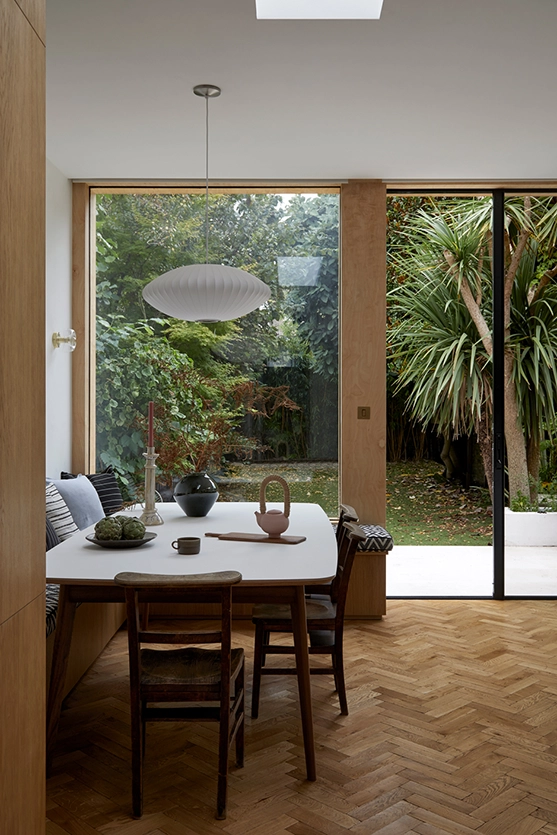
Ulrich’s patients did not need a garden. They needed a window that looked at something alive. That is the whole of nagame (眺め), the framing of a single view, and it is usually a better investment than more glazing. A rear wall opened end to end gives you a great deal of light and, very often, a great deal of fence.
At Botanic House in Chiswick, we placed a picture window to frame the rear garden, so that in January, with the doors shut and nobody going outside for weeks, the green is still in the room. That window is doing more for the house than a shelf of pots ever could.
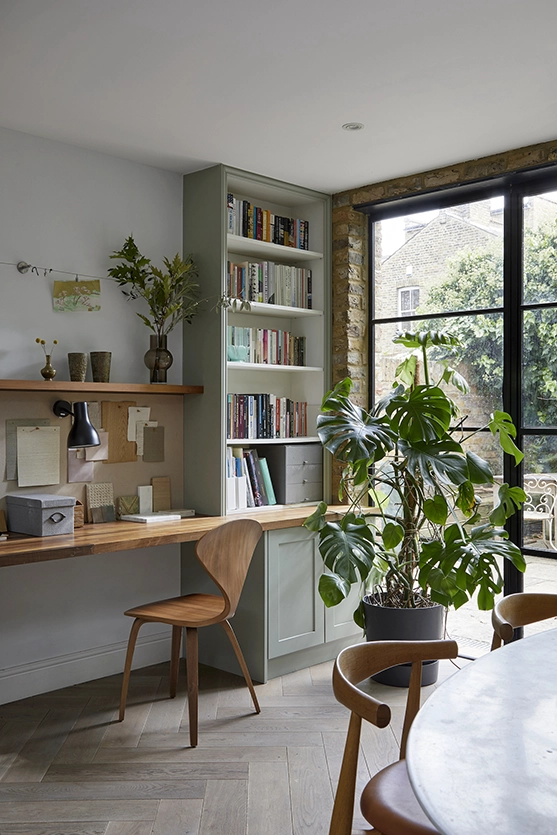
Then there is what the room is made of. Shizen (自然) asks for surfaces that age rather than resist ageing: oak that darkens, lime plaster that takes a mark, stone that wears where hands and feet have been. This is also a question of health, and a more pressing one in a child’s room, where smaller bodies and developing senses are less forgiving of what a surface gives off. Low-VOC paint, honestly sourced timber and air that actually moves belong in the same conversation as the planting, not in an appendix to it. We wrote about the air itself in The Key to Healthy Indoor Air.
A Wood on the Wall
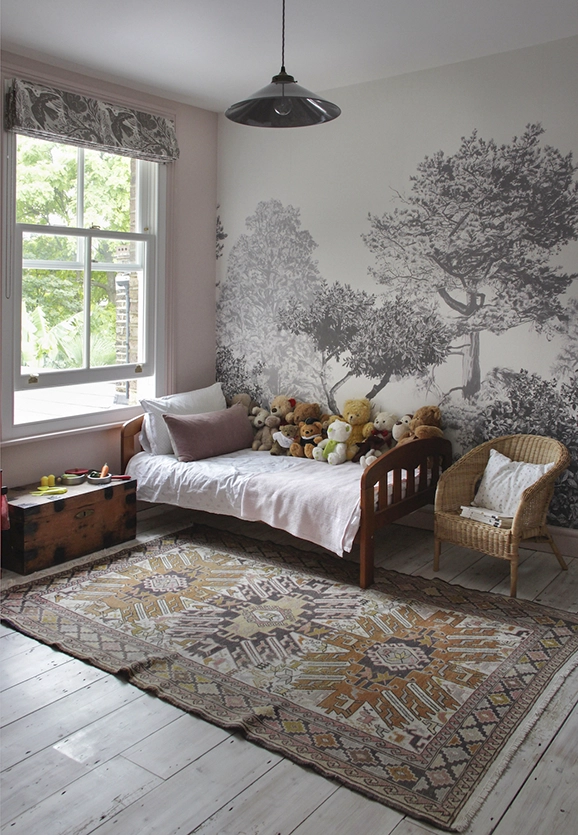
When Yoko Kloeden renovated her own home, Serene Design Vocabulary, in 2017, the children’s rooms were built around shinrin-yoku. Quiet colour, and forest murals covering a wall, so that three small children woke each morning inside a wood.
This sounds like decoration and is not. The research is clearer on this point than most people expect: a mural, a painting, or simply the right green can carry a good part of the mood-lifting, stress-lowering effect of a real window onto trees. She set the argument out in the Journal of Biophilic Design in 2025, and it has held up in every children’s room we have designed since.

Somewhere to Put Your Back
Children find the corner of a room and stay in it. They build dens under tables, wedge themselves between a bed and a wall, and read in the one spot where nobody can come up behind them. The instinct does not leave us. It turns into the window seat, the reading chair placed so the door stays in view, the kitchen bench nobody wants to give up.
Shelter is part of our relationship with the natural world, not separate from it — an animal preference for seeing without being seen. In a house it is usually a matter of a few hundred millimetres and a decision about which way a chair faces. This is ma (間) at work: space arranged so that a person can settle into it rather than simply pass through.
You Do Not Need a Forest
Most London houses do not look onto trees. They look onto other houses, a fence, a parked car, and that is a smaller problem than it sounds. London is full of commons, greens and garden squares, and almost none of us live facing one. What a house can still offer is one view worth having, a room made of something honest, a wall that suggests a wood, and a corner to sit in.
It is worth knowing which of these need looking after, because that is what decides whether any of it is still there in five years. A living wall lives as long as someone tends it. A garden deepens for years and then goes backwards quickly when attention stops. A mural asks for nothing. Oak and plaster improve on their own, provided they were the right oak and plaster to begin with. We made this argument at length in 30% Construction, 70% Care, and it applies here more than anywhere.
A house that holds nature well is rarely the one with the most greenery in it. It is the one where the connection was built into the layout and the specification, so that it keeps working without anyone having to keep it alive. Both kinds of house can be beautiful on the day the photographs are taken. Only one of them is still doing it in ten years.
