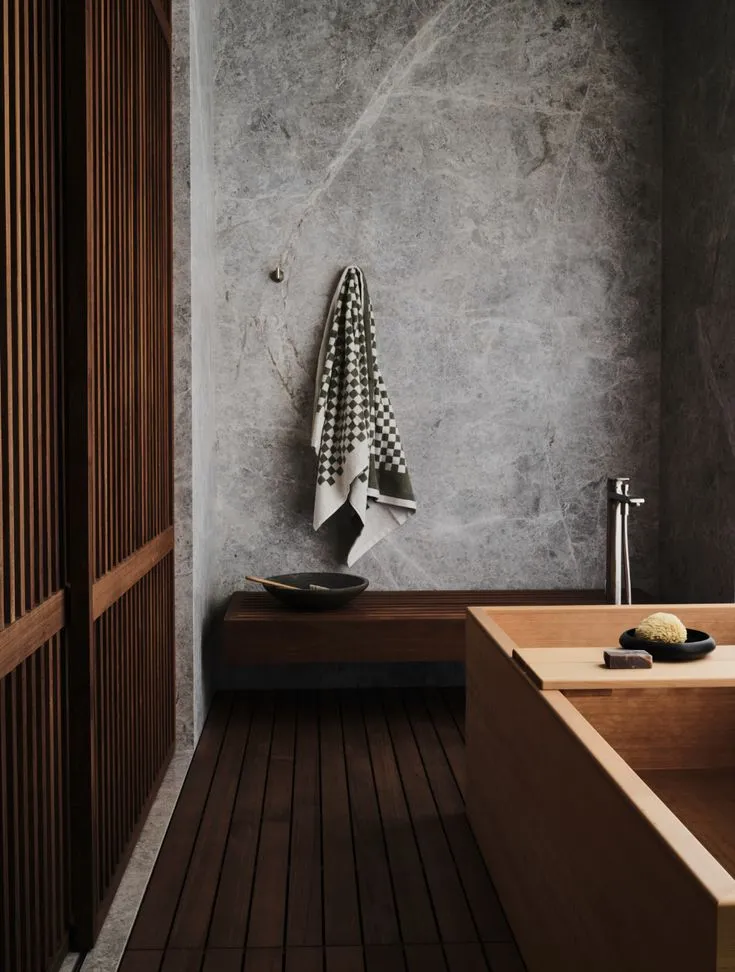
A Japanese bathroom is planned for stillness. You wash before you get in, not while you are in, so the tub is not where the cleaning happens — it is what comes afterwards, the close of the day and not a task inside it. That single inversion is why these rooms so rarely work when they are copied instead of planned. A room you pass through in four minutes before work and a room you sit in for half an hour after dark are not the same brief, and they do not want the same plan. What follows is where such a room wants to sit in a house, what it should look out at, how it holds its heat, and how it changes through the year. We are designing one at the moment in a London terrace, around a courtyard cut into the middle of the ground floor.

Planned for Seven in the Morning
The British bathroom works perfectly well. It sits upstairs off the landing, takes the smallest room on the floor, makes do with obscured glass or no window at all, and is built around a shower that has to perform at speed because several people need it inside forty minutes. The extractor runs. The towel rail comes on an hour before anyone is awake.
None of that is a mistake. It is the correct answer to a question nobody remembers asking: how do we get everyone clean and out of the house by twenty past seven? Move the room to nine at night and the question changes, and almost every answer changes with it.
The Last Thing You Do
In a Japanese house you wash and rinse completely before you get in. The ofuro (お風呂) is entered clean. Nothing is being removed in there — no soap, no scrubbing, no standing up to reach for a flannel. The tub is shorter and considerably deeper than a British bath, the water is run hotter, and you sit upright with your knees drawn up and the water at your shoulders.
What you are doing in there is stopping. Stillness is the room’s actual function, not a mood its finishes are meant to suggest, and it is the one part of the day with nothing attached to it – which is why it sits at the end. A bath at seven in the morning gets you ready for something. A bath at nine at night is where the day stops: work is over, and the house turns private.
How the room is built — the wash area, the depth of the tub, the separate WC and what each takes to achieve in a British house — we set out in How to Create a Japanese Bathroom. This article is the other half of it: what it means to plan a room around the end of the day.
Half an Hour in the Dark
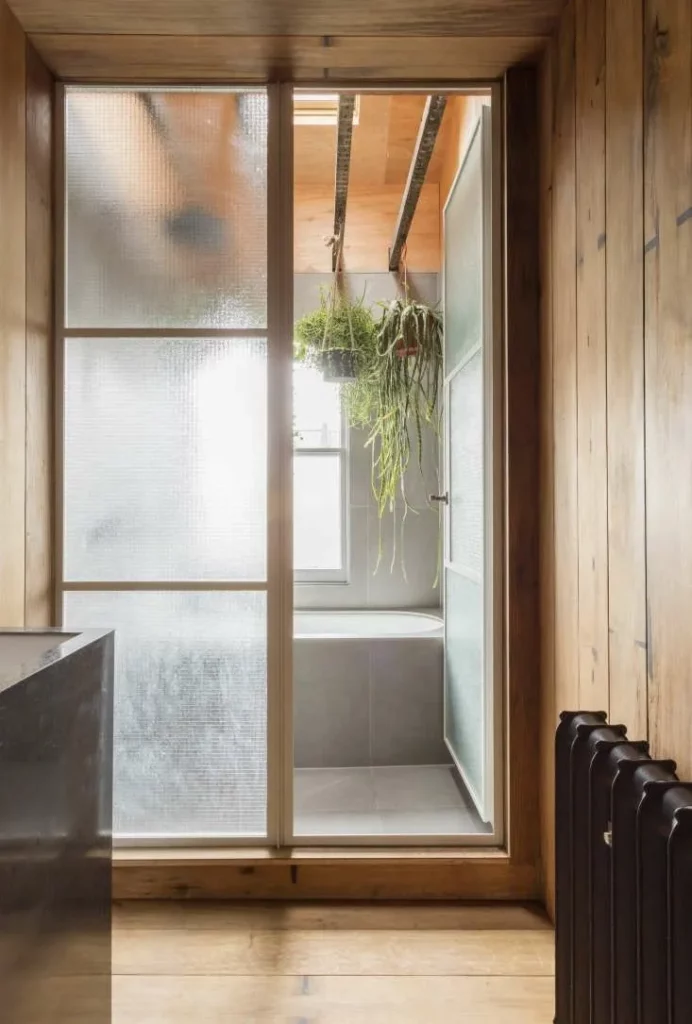
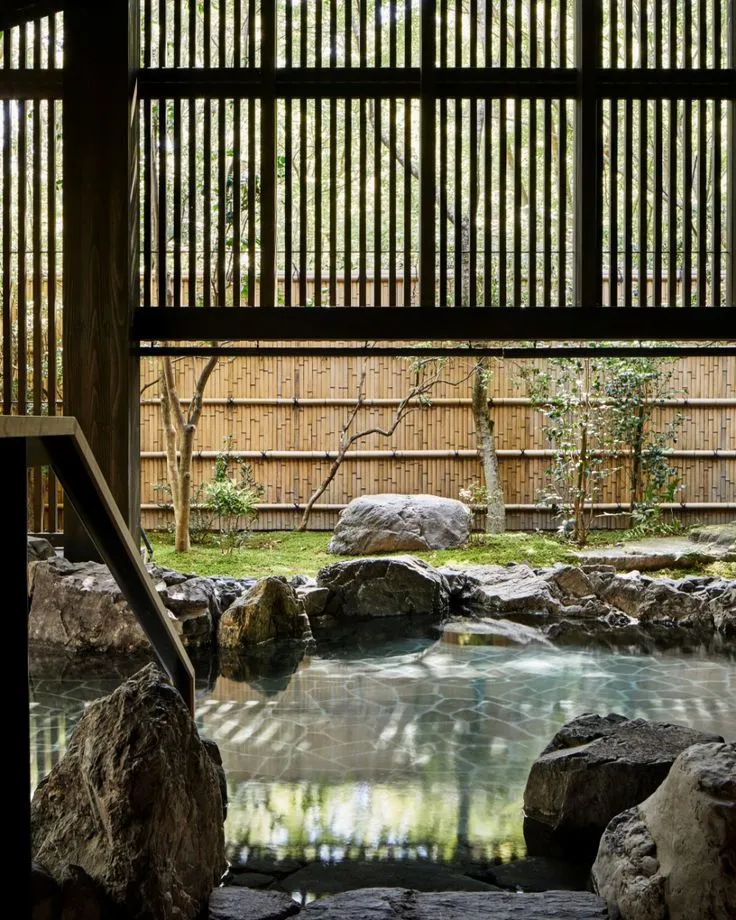
Begin with where the room goes. Somewhere you intend to spend half an hour should not automatically inherit the leftover space at the top of the stairs. In the terrace we are working on now, the main bathroom sits on the ground floor, beside a courtyard cut into the middle of the plan. We wrote about why that courtyard is there in The Case for Courtyards — it was put in to bring daylight into the deepest part of a long, narrow house. It turned out to do a second job. It gives the bathroom something to look at.
That is nagame (眺め), the deliberate framing of one view instead of the maximising of glass, and the bath is where it earns its keep. You are sitting still, at a low eye level, for half an hour, usually in near darkness. Whatever is in front of you then is the most looked-at thing in the house for its size. Here it will be a small enclosed courtyard, planted and lit low, visible from the bath and from nowhere outside the building.
Heat comes next, and it is not the heat a British bathroom supplies. Underfloor heating and a heated towel rail — which we specify as a matter of course — warm the room perfectly well for a shower. But a British bathroom also works hard to get rid of the steam. The fan runs, the mirror is kept clear, and the air you step out into is dry. A Japanese wet room does something closer to the opposite. Washing and soaking share one tiled space, and the bath itself, deep and full and kept covered between uses, warms that space. The steam is allowed to sit there while you are in it, the walls stay warm, and getting out of the water is not the small shock it is in a dry room. Japanese bathrooms are often warmed before anyone gets in at all, for the same reason: the gap between a cold room and a hot bath is the unpleasant part of a winter evening, and it is avoidable.
Then the separations. Undressing happens outside the wet room, in a dressing area that stays dry. The WC is a room of its own again. Each of those things wants a different temperature and a different floor underfoot, and giving each of them a room asks less of all of them than making one room do everything.
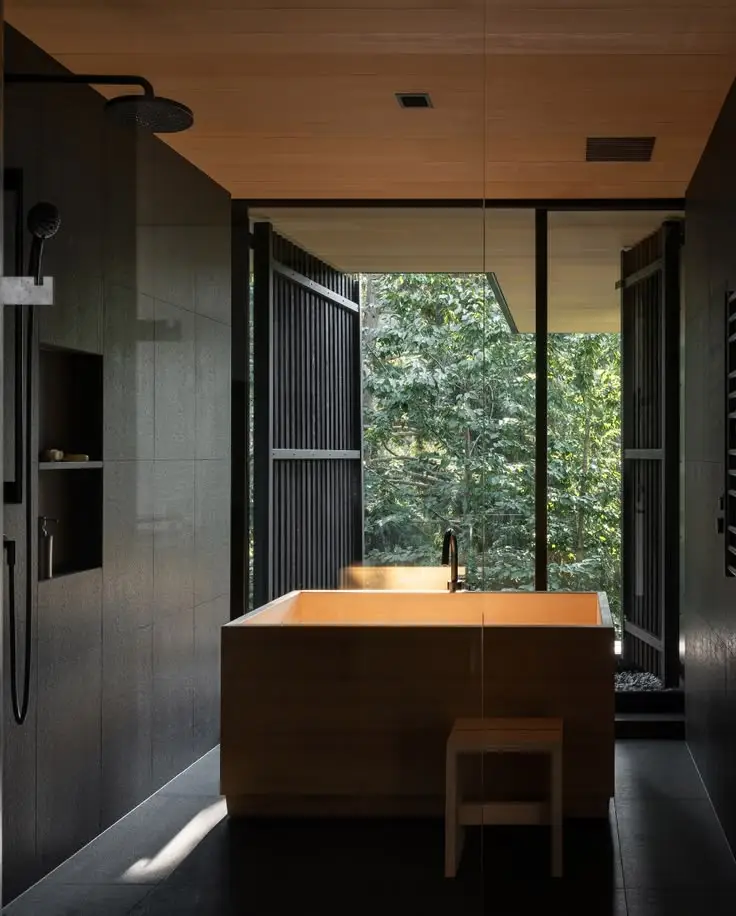
The materials answer to the same fact. The bath here is timber and sunk into the floor, so getting in is a descent rather than a climb. Hinoki (檜), Japanese cypress, is the traditional choice because it tolerates constant wet, holds its scent for years and warms under the hand in a way no acrylic manages. It also has to be allowed to age, which is the whole argument of shizen (自然). A sealed surface that still looks box-fresh in ten years suits a room you want to leave quickly. It does nothing for one you want to sit in.

Two Nights of the Year
Because the bath comes round every evening, it is one of the clearest places the Japanese year shows up at home. Yakutō (薬湯), medicinal bathing, is the old habit of putting something into the water for what it does rather than how it smells.
On the winter solstice, tōji (冬至), whole yuzu are floated in the bath. A yuzu is a small, knobbly Japanese citrus, somewhere between a mandarin and a lime, grown almost entirely for its peel rather than its juice; a handful go in uncut and the oil in the skin releases into the hot water. The custom is said to go back to the Edo period and the public bathhouses, and the usual explanations are as much wordplay as medicine — tōji, the solstice, sounds like the word for taking a cure at a hot spring. The scent is held to warm you and to keep colds and cracked skin away through the worst of the winter. On 5 May, the day now kept as Children’s Day, iris leaves go in instead: shōbu-yu (菖蒲湯), thought to have come across from the Chinese festival on the same date, and to have attached itself to warrior households because the word for the iris sounds like the word for martial spirit and its leaf has the shape of a blade.
Neither is really about the plant. The point is that the bath is the same every night, so marking two nights inside it is enough to tell you where you are in the year. Its modern descendant is nyūyokuzai (入浴剤), the bath additives on sale in every Japanese supermarket, which began as a way of approximating the minerals of a famous hot spring without having to travel to one. Most households keep several and choose by season. It is the smallest piece of seasonality a house can have, and it belongs to the same instinct we described in Japan’s Microseasons.
Nobody Argues About the Kitchen
A kitchen gets real design attention and nobody has to make the case for it. It is where the household meets and where guests end up, so it earns its drawings without an argument.
The bathroom is where the day ends, and it tends to get a fraction of that thought: a layout settled in ten minutes, a window position inherited from whoever lived there before, a specification chosen on how easily it wipes clean. That is a fair trade for a room used for four minutes. It is a poor one for the quietest half hour of the day.
You do not need a courtyard or a cypress tub to take the point. You need to decide, before anything is drawn, which hour of the day the room is for. Where it sits, what it faces, how warm it stays and what it is made of all follow from that. Get the hour wrong and you will build an excellent room to rush through.