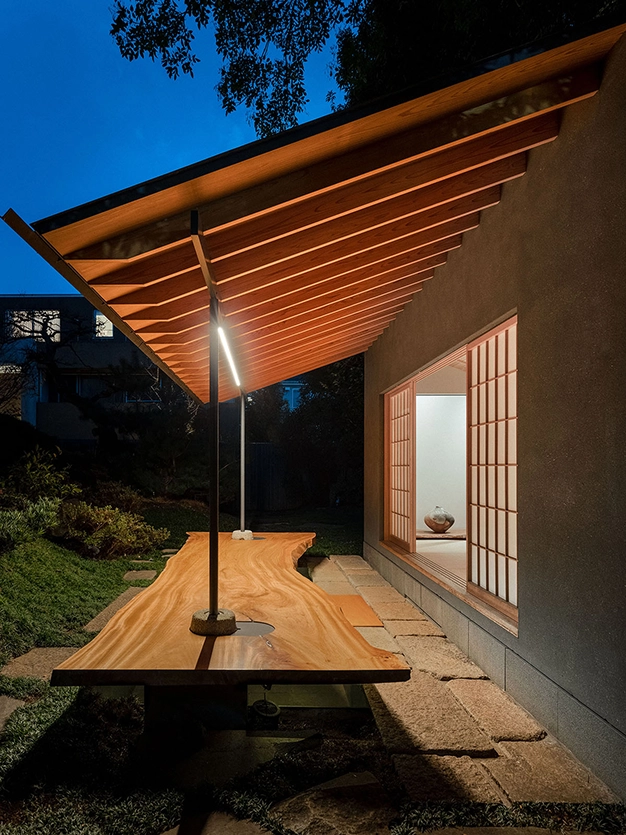
The way we design our homes reflects how we see our relationship with nature. As a studio working between cultures — rooted in Kyoto, practising in London — I have become increasingly aware that this relationship is under strain. Climate change, overheating buildings, and a growing sense of disconnection from our surroundings are forcing us to question assumptions about comfort and control that have shaped Western residential design for centuries.
For me, this is where Japanese spatial thinking becomes not just relevant, but essential. Not as a style to be applied, but as a way of seeing — one that treats the home as a living system that responds to its environment, rather than a sealed object that resists it.

Two Villas, Two Worldviews
To understand the difference, it helps to look at where our ideas about home originally came from. Across cultures, the way architecture engages with nature was shaped first at the highest levels of society — in palaces, villas, and aristocratic residences — before filtering down into everyday homes.
In Europe, one of the clearest expressions of this is the Palace of Versailles. Built in the seventeenth century as a symbol of absolute power, Versailles presents a worldview in which architecture dominates. Nature is clipped, ordered, and subordinated to human intent. The gardens are arranged symmetrically, every hedge disciplined, every vista terminating in a fountain or statue celebrating human artifice. That philosophy — of control, rigidity, and permanence — filtered down over centuries into homes that are sealed, mechanically conditioned, and designed to keep the outside firmly outside.
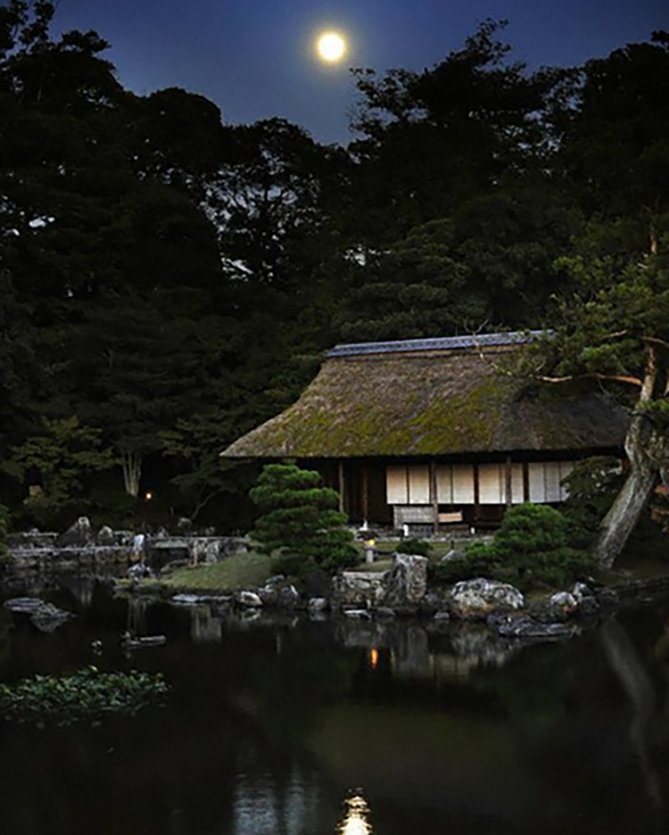
I grew up visiting a place that embodies the opposite. The Katsura Imperial Villa in Kyoto, built around the same period as Versailles, does not impose itself on the landscape. It listens to it. Architecture, garden, light, and season are inseparable. A sequence of pavilions arranged loosely around a central garden, with no single commanding axis. Sliding screens and layered verandas blur the distinction between interior and exterior. Rooms are oriented toward carefully framed views, and movement through the villa unfolds gradually, revealing changing relationships between building, water, and sky.
Katsura does not seek to control nature. It creates a framework for living with change — with shifting light, with seasonal cycles, with the weathering of materials over time. The house becomes a mediator between people and their environment, not a barrier against it.
These are not just historical curiosities. They represent two fundamentally different design philosophies that still shape how homes are conceived today. One extends human order outward. The other invites nature inward.

What This Looks Like in Practice
This philosophy shapes every project we take on at YKD. I do not see interiors as sealed containers to be styled and insulated from the world. I see them as spaces that mediate between the people who live in them and the environment around them. Framed views, transitional spaces, natural materials, and sensitivity to light and season are not aesthetic choices alone — they are tools for wellbeing and resilience.
At our Verdant Oasis project in Stoke Newington — a Victorian terrace where we designed the ground floor, interiors, and garden as one integrated vision — the introduction of layered natural light changed how the family uses the home. The client described it simply: the additional light made a significant difference to their mood. The garden became present in daily life, not separate from it. That connection was not achieved through spectacle. It came from flush thresholds, continuous materials between kitchen and terrace, and planting positioned to frame the garden rather than expose the whole garden at once.
In our Culinary Inspired Home in Brixton, the relationship between old and new became the central design idea. Heritage brickwork was left exposed. A living wall at the end of the garden can be viewed from anywhere on the ground floor as a permanent, breathing presence of nature. Materials were chosen not for visual impact alone, but for honest tactility — lime paint, reclaimed timber, hand-glazed tiles. The home was designed around how food, family, and nature intersect in daily life, not as a static composition.

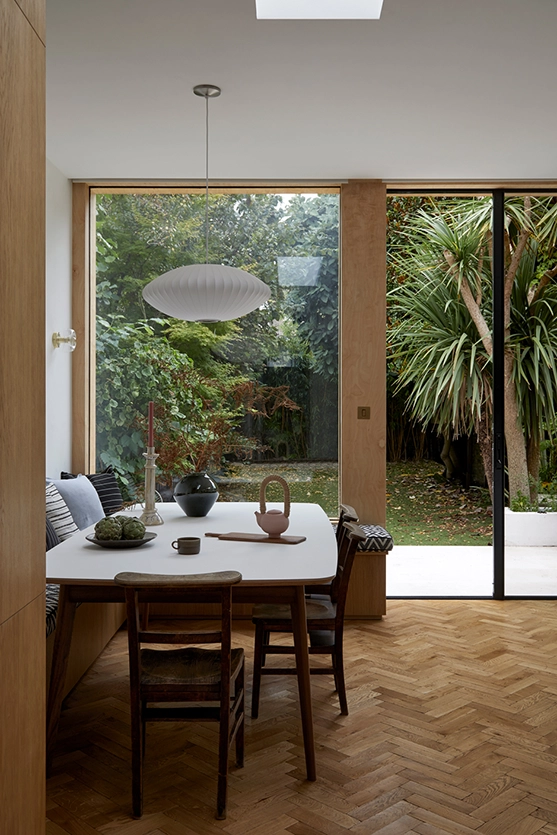
At Botanic House in Chiswick, we designed a large picture window specifically to frame the lush rear planting, so that greenery remains a presence even when doors are closed. The view becomes part of morning coffee, evening cooking, quiet moments at the dining table. This is the principle of Nagame — framing a view so that the outside world becomes an extension of everyday life. We explore this and the wider indoor-outdoor connection in our article Where Home Meets Garden.
In each of these projects, the home is not a finished object. It is a system — one that shifts with the light, with the seasons, with the life lived inside it. A shaded threshold reduces the need for mechanical cooling. A window aligned with planting improves mood before anyone can explain why. Materials that patinate over time grow more beautiful, not less. These are not incidental qualities. They are the outcome of designing with nature as an active participant rather than a backdrop.
Why This Matters Now
What strikes me is how timely these ideas feel, particularly in Europe. As summers grow hotter and weather patterns shift, the limits of sealed, rigid building models are becoming visible. Homes that rely entirely on mechanical systems for comfort are exposed. The traditional English garden — the manicured lawn, the thirsty herbaceous border — is under strain from drought and heat in ways that would have seemed unthinkable a generation ago.
Japanese spatial thinking offers a different starting point. Not control, but coexistence. Not permanence, but adaptability. Deep eaves that manage solar gain. Sliding panels that regulate ventilation. Gardens conceived as climatic buffers, not just ornamental features. These are strategies that have been refined over centuries in a climate far more demanding than Britain’s — and they are becoming newly relevant as European conditions grow less predictable. We have written about this shift in more depth in our article Designing for Climate Change.
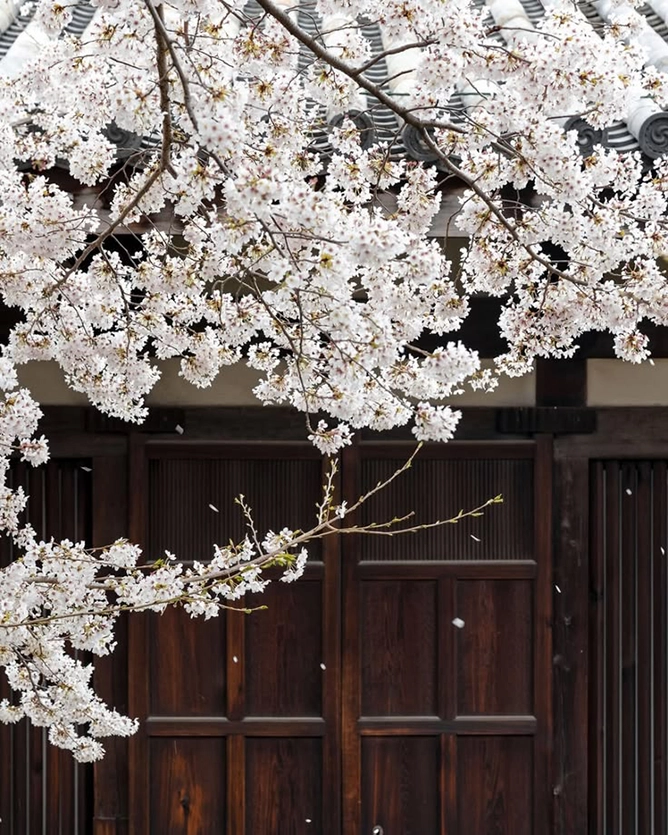
But for me, the relevance goes beyond environmental performance. It connects to something quieter — to Yūgen, the feeling of subtle depth beneath the surface. A home designed as a living system does not just function better. It feels different to inhabit. There is a calm that comes from spaces that acknowledge the world beyond their walls — the shifting of afternoon light, the sound of rain in the garden, the way a stone floor holds the coolness of morning. These are not romantic gestures. They are the qualities that make a home feel grounded, present, and deeply restorative. We explore this philosophy further in The Quiet Beauty of Yūgen.
An Attitude, Not an Aesthetic
I want to be clear about what this is not. It is not about recreating traditional Japanese houses in UK. It is not about a particular look or material palette. And it is certainly not about the surface-level fusion that has become fashionable in recent years.
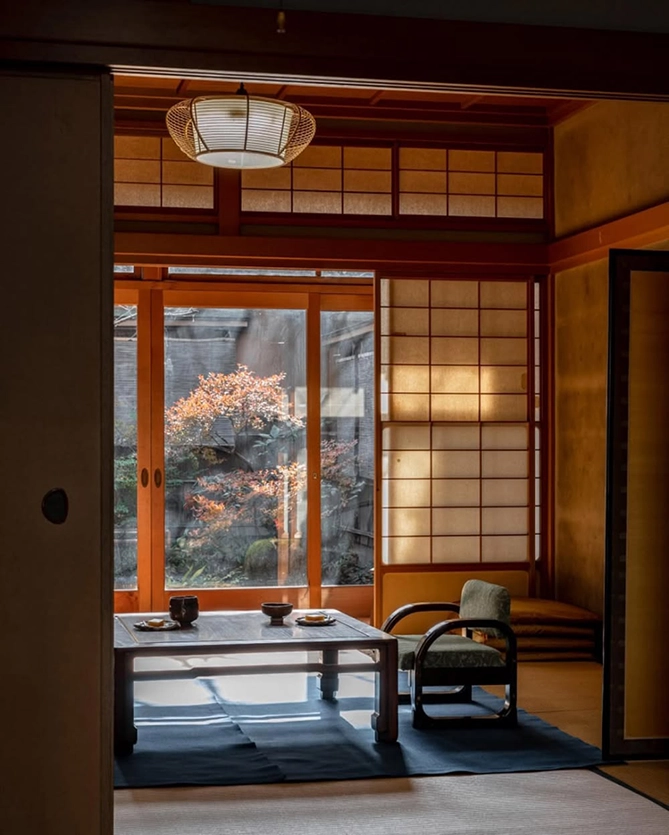
What Japanese spatial philosophy offers is an attitude of attentiveness. To how light enters a room. To how a threshold mediates between inside and outside. To how materials age. To the presence of nature — not as decoration, but as an active, living force in the home. Even a modest urban flat can benefit from this thinking. A 1950s terrace as much as a period semi.
Japanese design has always understood something that Western design is only now rediscovering: that nature is not a backdrop to be managed, but a participant to be respected. Shintō tradition saw rocks and ancient trees as dwelling places of spirits. Gardens were conceived as sacred ground, not utilitarian plots. That reverence is not mysticism — it is a practical recognition that when architecture works with the natural world, the result is more resilient, more beautiful, and more humane. We reflect on this relationship between Japanese design and nature in Is Japanese Design Biophilic by Nature?
The growing interest in Japanese spatial philosophy is not a trend. It is a cultural correction — a recognition that homes designed as living systems, rather than isolated objects, are not only more sustainable but more deeply felt.
Designing With, Not Against
Every project at YKD begins with the same conviction: that architecture, interiors, and garden should be conceived as one interconnected system. Not because it is efficient — though it is — but because it is how homes come alive.
As designers, we have a responsibility to create homes that support long-term comfort, environmental responsibility, and emotional wellbeing. When architecture and interiors are conceived as part of a larger living system rather than isolated objects, we begin to design spaces that are not only more adaptable, but more calm. And in a world that feels increasingly unpredictable, that calm is not a small thing.
Image credit: Keiji Ashizawa, Ben Richards