
If you are thinking about extending or remodelling your home, one of the first questions you will face is whether you need planning permission. It sounds simple, but the answer rarely is.
In England, certain types of building work are covered by permitted development rights — a set of national rules that allow homeowners to carry out improvements without applying to their local council. Other work falls outside those rights and requires a formal planning application. The distinction between the two has significant implications for your timeline, your budget, and the scope of what is possible.
In London, the picture is more layered still. Conservation areas, Article 4 directions, and borough-specific policies mean that two properties on the same street can face very different requirements. Understanding the regulatory framework clearly — before any design work begins — is the most valuable step you can take.

What Are Permitted Development Rights?
Permitted development rights are granted by Parliament through the Town and Country Planning (General Permitted Development) (England) Order 2015, as amended. They allow homeowners to make certain changes to their property without submitting a planning application, provided the work stays within defined limits on size, height, and position.
It is important to understand that these are not permissions given by your local council. They exist nationally. But they come with conditions — and your council can restrict or remove them in certain circumstances. Before relying on permitted development, it is always worth confirming with your local planning authority that the rights apply to your property.
The types of work most relevant to homeowners fall into several categories.
Rear extensions are the most common route for adding ground-floor space. Under Class A of the Order, a single-storey rear extension can extend up to 4 metres from the rear wall of a detached house, or 3 metres for a semi-detached or terraced property, with a maximum height of 4 metres. Materials should be similar in appearance to the existing house. There is also a provision for deeper extensions under the Larger Home Extension Scheme, which is covered separately below.
Side extensions are more restricted. They must be single-storey, no more than half the width of the original house, and with an eaves height no greater than 3 metres. Two-storey side extensions always require a planning application.
Loft conversions fall under Class B and allow up to 40 cubic metres of additional roof space for terraced and semi-detached houses, or 50 cubic metres for detached properties. Front-facing dormers are not permitted under these rights. Any side-facing windows must be obscure-glazed and non-opening, or openable only above 1.7 metres from the floor. Loft conversions work within the existing building envelope and avoid groundworks, which is why they remain one of the most efficient ways to add living space to a London home.

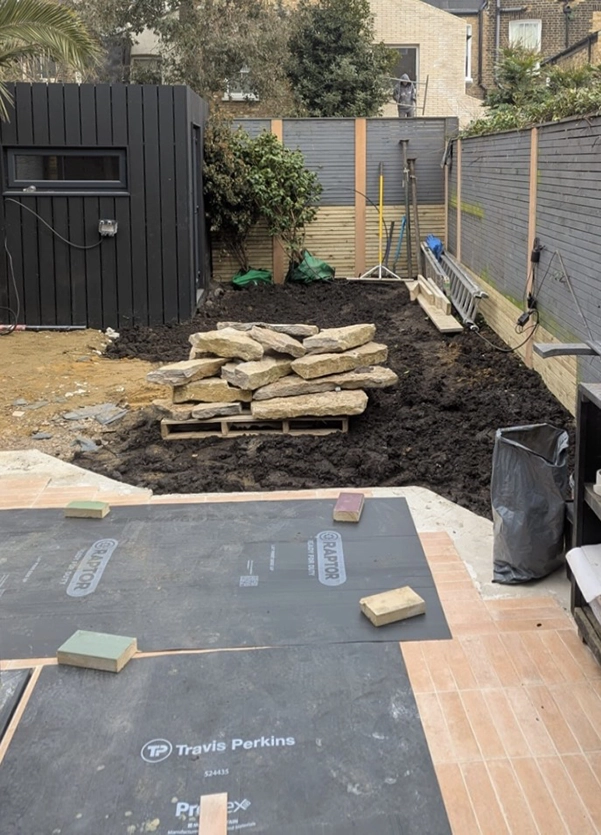
Outbuildings and garden structures are covered by Class E. These must be single-storey, located within the curtilage of the house, and used for purposes incidental to the enjoyment of the home — such as a garden office, studio, or storage.
Across all of these categories, a fundamental rule applies: the total area of ground covered by extensions and outbuildings must not exceed 50% of the curtilage — that is, the land surrounding the original house. Previous extensions, including those carried out by former owners, count towards this allowance.
It is also worth noting that permitted development rights apply to houses, not to flats or maisonettes. If your home was created through a change-of-use conversion — for example, from a former office or shop — householder PD rights do not apply, and any extension will require a full planning application.
When Planning Permission Is Required
Planning permission is needed whenever a project exceeds the limits set by permitted development — or when those rights have been removed or restricted. In London, this happens more often than many homeowners expect.
The most common triggers include two-storey side extensions, any extension that exceeds PD size or height limits, and work that extends forward of the principal elevation. If your property sits within a conservation area, an Area of Outstanding Natural Beauty, a National Park, or a World Heritage Site, permitted development rights are significantly reduced. Listed buildings always require listed building consent, regardless of the scale of work.
Article 4 directions deserve particular attention in London. These are issued by local councils to remove specific permitted development rights in defined areas — most commonly within conservation areas. Where an Article 4 direction is in place, even minor external changes such as replacing windows, fitting a new front door, or altering boundary walls may require planning consent. Many London boroughs apply these broadly, and it is essential to check whether one affects your property before assuming any work is permitted.
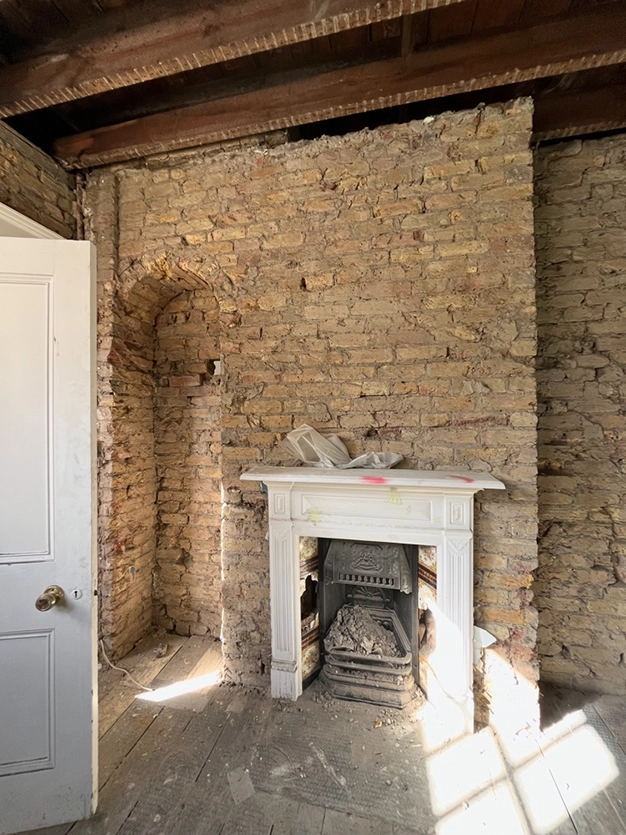

Basement extensions sit in a more complex area of the rules. In principle, excavating beneath an existing house could fall within Class A of the permitted development order. In practice, a High Court ruling (Eatherley v London Borough of Camden, 2016) found that the significant engineering works involved in basement excavation constituted a separate activity not covered by permitted development rights. Following that case, Camden introduced an Article 4 direction removing PD rights for basement extensions entirely. Several other inner London boroughs — including Kensington and Chelsea and Westminster — have introduced specific basement policies governing depth, garden coverage, construction methodology, and drainage. Kensington and Chelsea has permitted only single-storey basements since 2014.
Many London homes have existing cellars, but these typically lack the ceiling height and natural light required for habitable use. Building regulations require habitable rooms to have adequate ceiling height and a window providing natural light and ventilation. Converting a cellar to meet these standards usually involves lowering the floor — which is classified as excavation — and introducing a lightwell to the exterior. Both changes are likely to require planning permission, along with structural engineering assessments and, in many boroughs, a construction management plan.
In practice, basement projects in London almost always require a full planning application. This does not mean they are unachievable — but the approval process is more involved, and the supporting documentation required is substantially more detailed than for above-ground work.
The Larger Home Extension Scheme
There is a middle ground between standard permitted development and a full planning application. The Larger Home Extension Scheme — sometimes referred to as the prior approval process — allows for deeper single-storey rear extensions than PD would normally permit: up to 8 metres for detached houses and 6 metres for semi-detached or terraced properties.
This is not automatic. You must apply to your local council, which then notifies adjoining neighbours. If no objections are received within a set period, the extension may proceed. If objections are raised, the council assesses the likely impact — considering factors such as the effect on neighbours’ light and outlook — before reaching a decision. An objection does not guarantee refusal, but it does mean the proposal will be scrutinised more closely.
This scheme can be particularly useful where a standard 3-metre PD extension is not enough to create the kind of open-plan living space that connects meaningfully to the garden — a space where cooking, dining, and family life happen in natural relationship with the outdoors.
What This Means in Practice
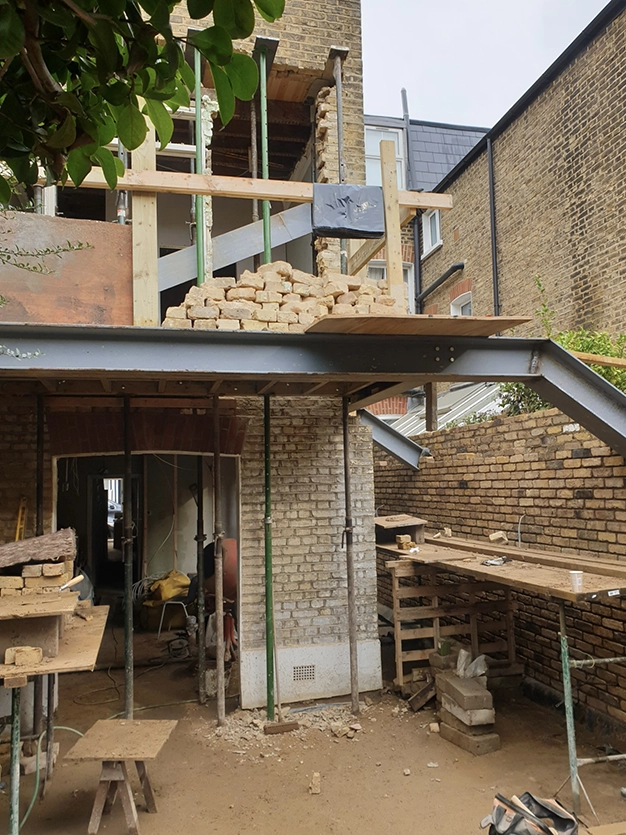
For most homeowners, the decision comes down to which type of extension best serves how they want to live. A loft conversion adds space efficiently within the existing footprint. A rear extension opens up the ground floor and, when designed with intention, draws the garden into daily life. A basement offers the greatest potential for additional area but carries the most complex approval process. Many projects combine two or three of these, and the approval requirements layer accordingly.
What we find is that constraints often guide more thoughtful design, not less. The question is rarely just what can I build? but what will make this home feel right? For more on designing within heritage restrictions, read Conservation Areas: Working Within Constraints. To explore how a rear extension can reshape the connection between home and garden, see Where Home Meets Garden.
Beyond planning, homeowners should also be aware of building regulations approval — which applies to almost all extension work — and, where relevant, party wall obligations under the Party Wall etc. Act 1996.
At YKD, every project starts here — understanding what your home allows before imagining what it could become.